
Donald Trump’s bold new deportation machine is sending migrants to countries they have never set foot in — paying hundreds of millions for the privilege.
The story
Teodoro (“Teddy”) Obiang junior was once on America’s naughty list. More than a decade ago prosecutors charged the son of the dictator of Equatorial Guinea — a small African petrostate — with extortion and embezzlement. They let him keep his ill-gotten Michael Jackson memorabilia (fedora, glove, “Thriller” jacket) but seized his Malibu mansion and Ferrari, and restricted his ability to enter America. Until last year, when the Trump administration welcomed him back [1].
In September, Mr Obiang walked into a meeting with the deputy secretary of state, Chris Landau, in Washington. They discussed energy and security — salient topics, given Equatorial Guinea’s cosy relationship with China and Russia. They also talked about illegal immigration. This was curious: the tiny country is no real source of illegal migrants to America. Instead, the administration was recruiting it as a destination [1][2].
What began as a diplomatic overture to a sanctioned dictator’s son has become the backbone of one of the most expansive — and secretive — deportation programs in American history. Under a web of often-classified agreements, the Trump administration has flown thousands of people deemed to be in the country illegally to nearly two dozen countries that are not their own [3]. At least eight African nations have signed on, including Equatorial Guinea, South Sudan, Rwanda, Uganda, Eswatini, Ghana and Cameroon [4].
“The Trump administration uses deportations to third countries as a legal loophole to indirectly force asylum seekers back to their home countries.” — Immigration lawyers, via Associated Press [3]
The numbers at a glance
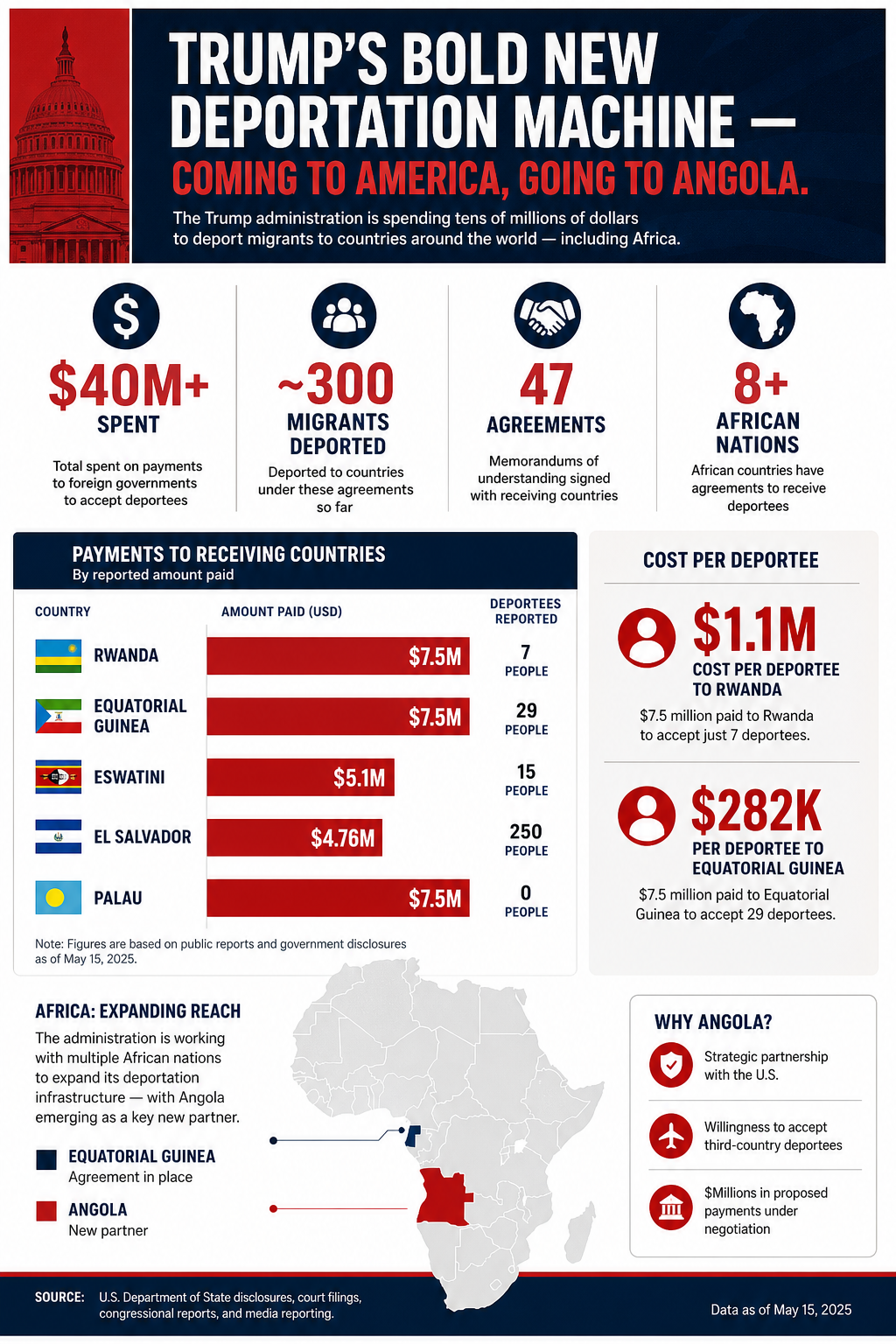
- $40 million+ spent on third-country deportations
- ~300 migrants sent to non-home countries
- 47 agreements in negotiation
- 8+ African nations signed up
- $1.1 million cost per deportee to Rwanda
- $282,000 cost per deportee to Equatorial Guinea
- 15 agreements already concluded
- 172 / 182 Equatorial Guinea’s corruption rank (Transparency International)
- 2026-27 Supreme Court term expected to decide the case
Who got paid, and how many people they took
The table below shows lump-sum payments to five receiving countries, versus the number of deportees each accepted, based on the February 2026 Senate Foreign Relations Committee staff report [5][6].
| Receiving country | Payment ($M) | Deportees received | Est. cost per person |
| Rwanda | $7.50 | 7 | $1,159,837 |
| Equatorial Guinea | $7.50 | 29 | $282,126 |
| Eswatini | $5.10 | 15 | $340,000 |
| El Salvador | $4.76 | 250 | $19,040 |
| Palau | $7.50 | 0 | — |
The economics are striking. Rwanda received $7.5 million plus an estimated $601,864 in flight costs to accept just seven people — about $1.1 million per individual. Equatorial Guinea took $7.5 million for 29 people, roughly $282,000 each. Palau was paid $7.5 million with no documented flights at all. El Salvador, by contrast, received $4.76 million for about 250 Venezuelan nationals, making it by far the most efficient recipient on a per-person basis [6].
Deportees sent to Equatorial Guinea, by nationality
The 29 people removed to Equatorial Guinea came from countries with which they had no prior ties [4][7].
| Country of origin | Region |
| Ethiopia | East Africa |
| Eritrea | East Africa |
| Mauritania | West Africa |
| Angola | Southern Africa |
| Congo | Central Africa |
| Chad | Central Africa |
| Georgia | Caucasus |
| Ghana | West Africa |
| Nigeria | West Africa |
The agreement pipeline
Of 47 third-country agreements at various stages of negotiation, 15 have been concluded and 10 are at or near conclusion [5].
| Status | Agreements |
| Concluded | 15 |
| At or near conclusion | 10 |
| In negotiation | 22 |
| Total | 47 |
Conditions on the ground
Once there, the deportees have been held in a hotel on Bioko island owned by President Obiang’s own family — converted into a detention center under the $7.5 million deal. Lawyers report 17 people held there (4 women, 13 men), all of whom had received U.S. court orders that should have protected them from removal to their home countries. Equatorial Guinea has no asylum policy, and at least 17 detainees have already been sent onward to countries where they may face persecution [8][9].
Oversight and the courts
The deals raise pointed questions about oversight. Equatorial Guinea ranks 172nd out of 182 countries for corruption, according to Transparency International — and the $7.5 million payment exceeds all U.S. assistance provided to the country over the previous eight years combined [6]. A federal judge in Boston ruled in February 2026 that immigrants must be given meaningful notice and time to raise country-specific objections, criticizing the safety assurances provided by third countries. The administration appealed; the case is likely to be decided by the Supreme Court during its 2026-27 term [10].
The bottom line
For the Trump administration, the appeal is clear: countries that refuse to take back their own citizens can be bypassed entirely by shipping migrants elsewhere. For the migrants — many of whom fled torture, sexual violence and political persecution — the destination is a country they have never known, run by a regime with little incentive to protect them. The deportation machine, once built around Obiang’s Malibu mansion, now runs on his son’s hotel in Malabo.
Sources
[1] Donald Trump’s bold new deportation machine – The Economist (economist.com)
[2] U.S. seeking deportation deals with far-flung countries like Angola and Eq… (cbsnews.com)
[3] Rights lawyers challenge Equatorial Guinea over migrant deportations | AP… (apnews.com)
[4] A secretive US deal with Africa’s Equatorial Guinea strands … (apnews.com)
[5] US spent $40M on roughly 300 deportations to third nations, report finds |… (apnews.com)
[6] US paid $32m to five countries to accept about 300 deportees … (theguardian.com)
[7] Equatorial Guinea sends eight of Trump’s nine deportees home, braces for n… (theafricareport.com)
[8] Deportees from US housed in same hotel in Equatorial Guinea as a suspected… (apnews.com)
[9] Ghana took in Trump’s deported West Africans. Then it forced them home | R… (reuters.com)
[10] U.S. Third-Country Deportation Agreements Are More.. | migrationpolicy.org (migrationpolicy.org)